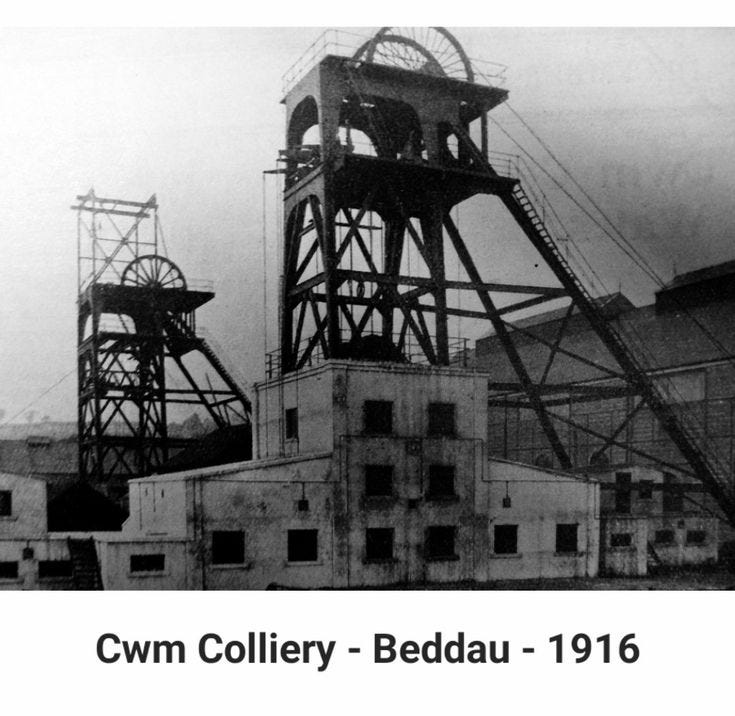
Cwm Colliery

Cwm Colliery and Coke Works in Beddau, near Pontypridd, was a major South Wales mining site that operated from 1909 until its closure in 1986, with the associated coke works operating until 2002. It was a key producer of foundry coke. Following closure, the site became a well-known, derelict, and highly contaminated industrial ruin.
Key Details About Cwm Colliery
Location: Situated in Tynant, near Beddau, Rhondda Cynon Taf.
History: The sinking of Cwm Colliery in 1909 by the Great Western Colliery Company Limited marked the beginnings of Beddau's rapid development. The company had been incorporated to sink pits in the Pontypridd area to provide steam coals for the Great Western Railway. The wife of the company's Managing Director, Mrs C.H. James, had the privilege of cutting the first turf. Among the local dignitaries were Lady Margaret and Lady Mildred Bramwell of Tir Mab Ellis. Their names were to continue an association with the colliery because the two shafts sunk were better known as the Margaret (upcast) and Mildred (downcast) Pits, each about 750 yards deep. Sinking operations were still continuing in 1913 when the pit employed 212 men, rising to 603 in 1918. In 1923, there were 1,043 men producing from the Four feet and Upper Five feet seams. By 1934 it was in full production employing 100 men on the surface and 780 men underground. In 1938 there were 1,269 men employed. Powell Duffrun Steam Coal Company acquired the colliery in 1928 and worked them until the mines were nationalised in 1947, when the workforce numbered 1,154. Cwm Colliery developed throughout the inter war years and after World War II, both manpower and production increasing significantly. An underground railway linking the Maritime Colliery, Pontypridd with Cwm was completed in 1931. A £9 million reconstruction scheme took place between 1952 and 1960, which included in 1957 a similar railway linking Cwm with Coedely Colliery, over 5km to the west. The merger of these two pits created the largest colliery in the South Wales Coalfield.
Peak Operation: In 1960, the colliery employed 1,470 men and produced 324,794 tons of coal. By the 1970's the collieries jointly produced 515,000 tons of steam coal a year from the Six feet and Yard seams with a workforce of 1,580 men.
Coke Works: Cwm coke works opened in 1958. It was designed to centralise and maintain the production of South Wales foundry coke. The coal mined at Cwm was very suitable for foundry coke given its low sulphur content.
Closure: The colliery closed on 28th November 1986 following the miners' strike but a British Coal publicity brochure published in 1982 stated that ‘a further underground development is exposing coal reserves of 9 million tonnes’, while the coke works continued operating until June 2002.
Aftermath: The site became a popular, albeit dangerous, location for industrial explorers, characterized by large, rusting, derelict structures. The site has since undergone demolition and land reclamation efforts. Extensive area of dumps currently remain, only partially landscaped and with new material being exposed all the time in drain-off runnels, between Church Village and Beddau Coke Works.
Legacy
The site is featured in various urban exploration reports and has been documented through drone footage, highlighting the scale of the former, abandoned industrial operation.
It is remembered as a significant employer in the area, fundamentally shaping the community of Beddau.